Nothing is Permanent – except change
Life and Death
Part One
THERE is a legend about a woman who went to Buddha to ask him to bring her dead child back to life. He thought for a while, and said perhaps this could be done, if she first brought him a certain type of bean; but it had to be from the house of a family to whom death was not known. Eagerly she went from house to house, for this bean was a common food. But in each home she heard the story of how a wife, or husband, child, mother or father, or some relative had died. Slowly she realised that death had visited all, and the hurt ebbed from her own loss.
All religions, philosophers, mystics, sects and thinkers of the world, have explained death in their own way. Some have denied all consciousness after death, others have said that life itself was the real state of unconsciousness, and death, in reality, a waking up.
In a letter I received recently, a woman described an interesting experience:
‘I was desperately ill at the time, dying in fact, and I heard a voice counting, (the woman was having an anaesthetic) and knew that when it reached five there would be sweet oblivion, release from the pain and confusion.
The voice reached five. For a time there was a great noise and flashing lights, as if every cell in my body was exploding. For a few moments I knew nothing, and then there was awareness, but no pain, no confusion.
It was very dark, very quiet, very still. I could not speak, nor hear, nor see, nor move. At first I thought I must be asleep, and I made a great effort to wake up, but I could not. Why doesn’t someone wake me? I wondered; Perhaps I was dreaming, but no, I knew I was not because I was conscious of my thoughts. I became aware that I was not breathing, nor did I feel any need to breathe. I could feel no part of my body.
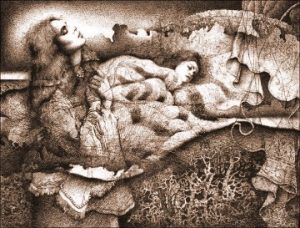 |
I’m Dead!Suddenly, the truth hit me. I was dead! Can you possibly understand how I felt? It was such a huge unacceptable truth. DEAD! DEAD! DEAD! The word pounded on my consciousness. No – No, I cannot be dead. I cannot accept it. How can I think if I am dead? I put the thought away from me.
|
Then I thought of my family. I felt a deep regret that I hadn’t told them more often how very much I loved them, and I felt a deep sorrow that I would not see them again. I thought about my life, about the things I had done and seen; about the people I had known, and the places I had been. I thought about everything that was worth giving a thought to. How long had I been ‘dead’? Time seemed to have ceased to exist. Was it hours, days, years, or even centuries?
So far all my thoughts had been outwards. I had not dared to dwell on the thought that I was dead. But now I knew I must search deep into my mind, to find help for the panic which threatened to submerge me.
Who am I? What am I? Where am I? Have I always been like this? Perhaps this is my natural state, and if so, my life must have been a dream. But if it was – and suddenly the full implication hit me – neither the world nor mankind, really existed. I thought again of my ‘life’. Had it only been a dream, not real? But surely that was impossible!
It took ages for this possibility to sink in. It seemed an eternity before I came to the next inevitable thought. I must be God. But no, God and any kind of philosophy was of man’s creation; therefore, if mankind was only a large figment of my imagination, God would not exist.
I was alone. So utterly and absolutely alone. There was no space, no time, no anything. Even I myself did not exist except as a mind, a lonely consciousness, a still quiet awareness. I had come to the very beginning of thought, the birthplace of the soul. My mind had gone round and round in ever decreasing circles and had at last come to this void where there were no more thoughts, only awareness. My soul cried out in utter despair and loneliness. “Is there no other consciousness, no love, no comfort? Please God, help me.”Then I heard the words from another Being, another Mind. “I am the Father. The world was my Dream; Come!”
I was lifted up into the arms of God, a God whom I had thought could not exist. I knew then the “Peace that passeth all understanding”: that supreme joy, that Knowledge of the Ultimate Truth, that Absolute Ecstasy which I cannot begin to describe. There are no words for the complete Love and Light which enveloped me. I was a thought in the beautiful mind of God. I was in Heaven. It would be like this for eternity. But then I heard the words – “Go back now and tell them all about it.”
Slowly, very, very slowly, my senses returned. I was very dazed for a while. The doctors thought I would never come out of the anaesthetic. This happened three years ago, but I have never told anyone before because I suspected they would think me mad.

The problems posed by sleep and death were among the first that early men and women sought to understand. Their method of enquiry was by direct experience or intuition, as it revealed itself in dreams, or visions, or experiences such as that described above. For primitive peoples, dreams were as real as waking life; they were approached much as Freud approached them, as expressions of an inner life. Within the dream people spoke with their dead, and gained information concerning them. Direct experience was also gained by those who survived death, or who could consciously enter a death-like state.
The beautiful place
Today, all these avenues of enquiry are still open to us. The woman’s experience quoted is an extremely clearly expressed one of her sense that death is not the end of personal existence. Recently a friend of mine told me of a similar case. The friend works in a young adults’ centre, and four of the young men there were involved in a road accident. All four were seriously injured and unconscious. As my friend regularly practises prayer and meditation, she prayed for them. However, three of them never regained consciousness. But the fourth, a young man, eventually returned to physical awareness.
When he met my friend again, he told her an interesting story. While they were all unconscious, he said, they were all awake and together in a beautiful place. They suffered no pain and were happy there, and he told my friend of this because occasionally, while the four were in the ‘beautiful place’, they often became suddenly aware of her presence and support. For her this presence was an expression of her prayers.
All over the world, people have died and then been resuscitated. Electric shock, drowning, heart failure, medical operations, and many other causes, have brought about a cessation of breathing and heartbeat. Some have ‘died’ in this way for only a few seconds, others for longer. The people who have returned from the these experiences come from all walks of life, from all age groups, from all educational levels. Many of them had never previously thought about, or studied, the subject of dying. Yet the descriptions of their experiences are strangely alike. Not all remember anything. But those who do tell a similar tale.
Let me quote from two of these descriptions, and then give you a composite picture built up from many such experiences.
My Experience of Death
The first is a married woman, a friend of mine. She was taken to hospital seriously ill and in great pain. As she was on the danger list, her husband was called and sat with her. As time passed, she began to notice the pain lessening. Slowly, she reached the point where all pain and discomfort had gone. She felt strangely light and wonderful and was amazed to find herself floating above her body.
As she adjusted to this new situation, she became aware of a distant call – a beckoning beauty – an indefinable music, which urged her to go to it. This held out to her such a promise of wonder that she longed to be away, but she was intensely aware of her husband.
Her body had stopped breathing, but her husband was overcome with the desire for his wife to live, and she knew, in this transcendent state, his every thought. His soul was as visible to her as any landscape, and she saw his anguish, his love, the difficulties he felt facing bringing up their child alone.
Then she knew she could not go. She must hold on somehow and leave the ‘Promise’ until another time. And with this thought and decision, she sank into her body again.
Gradually, the pain and distorted consciousness returned, and it was weeks before she recovered properly. Both her husband and the nurses. told her afterwards that they thought she was dead, but that suddenly she seemed to come back to them.
Washed ashore
The second case is of a little boy. With his brothers and friends he went to bathe in a mill pool. He was only four or five at the time, and could not swim. In the recklessness of their-play, one of the children pushed him into deeper water. At that moment, the mill gates opened and water rushed through carrying him along. He was drowned – but some adults who were hastily called to the scene managed to pull him out and revive him.
 |
As his father carried him home in his arms, the little boy talked about his mother, who had died some years earlier and at first his father smiled at his story.The boy said that as he went under the water he felt himself sinking down and down into darkness. Then there was a change and he felt himself rising up slowly until at last he rose to the surface.He was in a huge sea. Around him, other people were also surfacing, and all were being gradually washed towards the nearby shore. There on the beach, people waited, and greeted those who were brought to them by the sea.
|
And as he himself drew near there on a small promontory were his grandparents waiting to welcome him – and in front – his mother, and she bent to draw him into her arms. She took hold of his hands and as she did so, a cross around her neck swung before his face. Sparkling in it were seven stones. But at that moment, something seemed to pull him away, and he sank into the sea and at last awoke on the riverbank.
The other half of the Story
At the conclusion of the story, his father’s condescending smile vanished. They were now at home and his father left the room, obviously deeply moved. Only years later did he tell his son the other half of the story.
The boy’s mother had died when her son was tiny and she had died on her birthday. For many weeks before, her husband had saved for a special present which he had kept secret. On her death, heart-broken, he had crept down to the coffin in the middle of the night, unscrewed the lid and given the present to his dead wife. It was a cross with seven stones, and the secret of it had been buried with her.
Putting together a picture of many such death experiences, we can begin to see a general view of what it might be like, what it certainly is for some, to die.
First of all comes a lessening and eventual disappearance of bodily sensations. Although all pain and physical awareness goes, most people are still conscious of their physical surroundings and of other people. In fact they often watch their own body breathe its last struggling breaths.
Usually people see themselves in a body, but it’s sometimes more perfect than the body they have just left. Their perceptions are nearly always enormously heightened in many ways. There seems to be no sensation of gravity or weight – the whole room or area can be seen instantaneously, as if with circular vision, and there is an awareness of the thoughts and emotions of those present.
Distant music
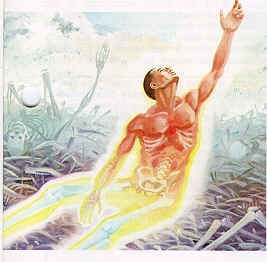
Sometimes a ‘dead’ relative or friend appears on the scene and leads the newly dead away to their new experience. But often a transition stage occurs. Distant music or scenery or voices, seem to call the person away. Here, thoughts and desires are immediate realities. The desire to stay roots one firmly to the spot – the desire to explore is itself sufficient to move one without any effort to walk.
This is what is meant by the term ‘earth bound soul’.
Those who have explored this level of awareness to some extent, say that due to circumstances being created by our innate thoughts, passions and desires, a person creates their own heaven and hell. Or alternatively, they may be bound to their physical surroundings, but minus a body. This inability to explore and mature into their new life, occurs because they are unable to let go of desires which can only be satisfied in a physical body – or else are possessed by malice for, or dependence on, someone still in the body.
 |
In her book ‘Twenty Years A Medium‘ Ursula Roberts gives an example of such a case. She had been called to a house because of some strange events. The house owners felt that some presence was trying to push them down the stairs, and when the wife climbed the stairs wearing a pearl necklace, she felt an unseen hand tear at the necklace, and break it.When she arrived to investigate, having clairvoyant vision Ursula Roberts noticed an old man standing at the top of the stairs. As she began to climb the stairs the old man threatened her, and told her that he would push her down the stairs. |
But she was used to dealing with the ‘dead’ in this way, and went up and asked him why he was making such a nuisance of himself. Angrily, he claimed that the present occupants had stolen his house, which should have passed to his children. When asked for proof, he led Mrs. Roberts to the basement and pointed to a space above a door. There, very dusty old papers were found proving that the father of the present occupants had cheated this old man out of his house. It was quickly given to his descendants and never again was there a troublesome presence on the stairs.
Free from painful thoughts
Joan Grant, in some of her books, also tells how she was able to free several suicides from their earthbound condition. In ‘Time out of Mind’ she describes the case of a man who had thrown himself in front of a train. By gradually freeing him of fixed and painful thoughts, and leading the direction of his ideas towards his daughter who was already dead, she led him out of his situation.
In our own culture, few of us are given any education in the matter of dying, and this may cause problems at the level of experience we are talking about. We may even have fixed and false ideas, which bind us to them. Nevertheless, most people who die and are then resuscitated, find an intuitive flow of guidance. Many go through one of the other early death experiences – namely, the re-experiencing of one’s entire life memories.
Awareness of the void
In general, the returned dead usually pass on from this experience to an awareness of the Beautiful Place, or, as Spiritualists call it, the Summerlands. From here, where old friends and new are met, they are snatched back into ‘life’. Very few, like the woman first quoted, go on through other aspects of dying, into direct awareness of the void, God and Eternity.
But if we are to gain an understanding of why such things occur, and realise the greater pattern of death, we cannot rest at merely repeating what others have said. We have to look into our own life and see its direction death-ward, and its point of entrance at birth.
We must look at the whole spectrum of human experience, belief and knowledge, not at just one of the many colours such as science or religion. Perhaps in this way we can begin to gain an inner awareness of dying. But more important still, maybe we will come to see what it is to LIVE!
Link to Part two