The Man and the Master
A story about Cheiro (Count Louis Hamon)
Printed in The July 1965 issue of Prediction in the UK.
The many guests in the ballroom crowded round to hear the contest of words and will. “You are a charlatan and a fool if you believe I can’t see through your pose. Your only power is the credulity of others. The greater the fools that come to you, the greater your so called power.” From such a lovely young girl, spoilt beauty though she might be, these were harsh words to cast at one with such an enormous reputation. But the man remained calm, smiling slightly at the girl’s vehemence.
“After such abuse I should be angry, but I prefer not to argue. Will you not apologise and let us end this?”
Under control now, the girl laughed musically. “Because you have all these gaping women here at your beck and call, do you trunk you can bring me to your feet, too?”
His reply, emphasised by his rugged handsomeness and fame, were heard throughout the now quiet hall. “I do not think – I know – I can. Come, now, apologise! If not, then at midnight you shall come and kneel at my feet in humble apology.”
 |
The girl strained forward towards him as if about to spring. “You are not only a fool, you’re raving mad. At midnight I shall be asleep. In fact I am going to bed now – good night!”And with that she made a grand exit from the room.A challenging situation indeed, but the women in the ballroom were with him as a body; the men could only speculate on the strange meaning of the little drama. But their speculations needed little patience, for midnight was close at hand. |
The man, in his immaculate evening dress, stepped to the door opening on to the stairs and opened it. Explaining the great need for silence to the intrigued guests, he switched off the lights, leaving the hall lit only by a blazing fire in the open hearth.
In the centre of the room he stood, apart from the others, silent and impressive. Silence indeed was everywhere. Except for the sparkling fire and a distant clock striking twelve.
Even as it ended a lithe figure glided into the room dressed only in a thin silk night-gown. Walking directly to him, her beautiful young limbs showing clearly against the firelight, she knelt before him and bowed her head to the floor in supplication.
Why Cheiro Left
It was a scene that etched itself deeply on all who watched, like some ancient magical ritual stirring in its mystery. The spell was only broken when the man quietly commanded the girl to return to her bed, and moments later he left the house that she might not he embarrassed by his presence in the morning.
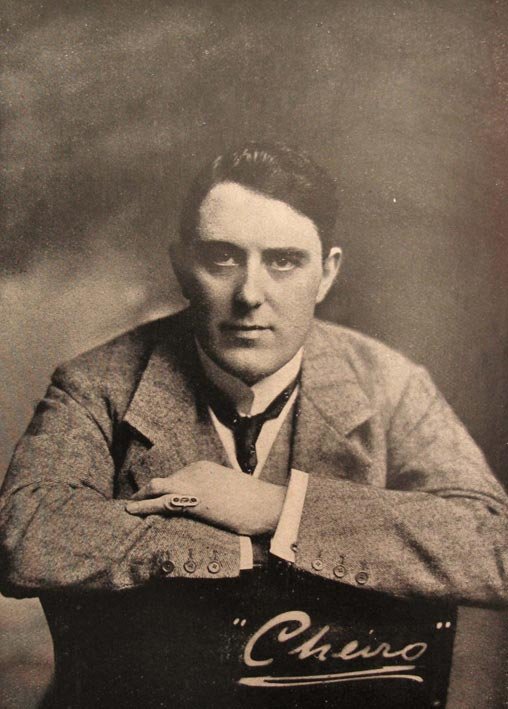
The girl’s name we are not told. The man’s name was Cheiro.
In the occult world of the beginning of this century, Spiritualism Theosophy and Anthroposophy had all stormed into the public’s notice. Yet alone, by sheer genius and magnetism Cheiro enter intimately, not only into the life and welfare of thousands of individuals, but also into the welfare and progress of society itself.
Most people who know his work see him as a great palmist, seer and numerologist. He was more than that. He was, and he retmains, a mystery.
In trying to penetrate this mystery we find that his real name was Count Louis Hamon. We also find his biographer, Edith Halford Nelson, dedicating her book Out of the Silence to “Cheiro A Rosicrucian”. Among his own writings we cannot find any claims connecting him with this Order. But neither did he confess openly to many of his own other achievements.
Apart from the foreword, after reading his ‘Confessions’ he appears to he an interesting but harmless person. Yet he was a man of many guises and many abilities. Besides his occult career, his path often took him into the role of secret agent. This would be either for a minister, or in connection with private schemes that affected the financiers of the country.
The Same Spirit
Yet to students of his life, his actions are only hints of the spirit that moved him, the same spirit, quoting Madame Blavatsky, “that incarnated into the great occultist Cagliostro”.
Cagliostro’s life is as deeply interesting as Cheiro’s, but made stranger still by the age in which he lived, and the obscuring hand of time. Rigely Evans says of him-:
“It is not enough to say that Cagliostro posed as a magician or stood forth as the apostle of a mystic religion . . . Cagliostro impressed himself deeply in the history of his time. Princes and nobles thronged to his magic operations, and prostrated themselves before him for hours”.
He, with the Compte de St Germain, watered the current that swelled into the French Revolution. Although Rudolph Steiner disagreed with Blavatsky in her idea of Cheiro being a reincarnation of Cagliostro, Edith Halford Nelson, from her years of intimate dealing with Cheiro, was inclined to agree with Blavatsky.
From her early childhood she had recurring dreams of an ancient eastern city in which a tall, dominating figure predominated. In later years, because of certain features, she was able to recognise the city as Alexandria.
Affinity With Biographer
As for the gentle Greek philosopher, to whom later dreams gave the name of Demetrius Phalerus founder of the Alexandrian library, she met him face to face when she was seventeen. His name? Cheiro!
There seemed to be some strange affinity between them linking their lives at points. On impulse she entered his Bond Street consulting rooms to have her palm read. She found it crowded with people waiting on a chance of an unfilled appointment.
The secretary was just explaining that all appointments were booked for two weeks when Cheiro, showing two clients out, noticed her. Immediately he called her into his room despite his secretary’s protests.
Later, he induced a trance state in her in which she recalled glimpses of their togetherness in past existences – past times in which she states that he was perhaps Akhenaton, but definitely Cagliostro and Demetrius Phalerus.
There must be many so called occultists who claim, either openly or obscurely, that they are the incarnation of such men. Something so refreshing about Cheiro was that firstly, he made no such claims, and secondly, his life and abilities made such claims unnecessary. Where needed, others recognised him for what he was and that was enough for him.
One day, for instance, while he was in St Peter’s at Rome after having attended the Mass, he noticed an old man looking at him analytically. I say old, because the man gave the impression of great age, yet his features and bearing had great virility about them.
The Mysterious Package
After a few moments the man came over and apologised for his strange behaviour, and told Cheiro that he believed he had something of interest for him. “Please be here at this hour tomorrow,” he said.
Cheiro, being naturally inquisitive, and intrigued by something indefinably mysterious about the man, could hardly wait for the time of his appointment to arrive. When at last it did, the mysterious gentleman came to him, and with little ceremony handed him a package. The contents of the package he said were a sacred trust his family had held. Now the moment had come for them to be returned to their rightful owner – Cheiro.
As strangely as he came into Cheiro’s life, his exit was as mysterious, and Cheiro hurried back to his hotel, eager to examine the contents of the package.
These can be described in a few words. They were translations of manuscripts of extreme age, giving particulars of occult and alchemical formulas of very great use to Cheiro in his work. It is thought that they were part of the collection of manuscripts at one time in the Alexandrian Library.
Hand of a mummy
At another time in his life he was given the hand of an Egyptian mummy, by an Arab mystic. The Arab recognised him as one who would resurrect the ancient art of palmistry, and gave him the hand of an Egyptian mummy that had been passed down for generations, that together they might work out their destiny.
It was because he was a man of immense experience and worldliness that so many great and humble men and women sought his aid and advice. They knew that apart from his insight as a seer, they would he confronted with a man who would understand and sympathise through having lived life to the full.
A seer? Yes. A mystic as well, but also a lover, an adventurer, and most important of all, a man. Who but he could be seen by a Tibetan Monk as an “Incarnate”; by a woman as a lover, and by a mystic as the “Master”?
Who Was He
“As mentioned in his memoirs, Cheiro acquired his expertise in India. As a teenager, he traveled to the Bombay port of Apollo Bunder. There, he met his Guru, an Indian Brahmin, who took him to his village in the valley of the Konkan region of Maharashtra. Later Cheiro was permitted by Brahmans to study an ancient book that has many studies on hands; the pages of the book were made of human skin and written with gold and it is still guarded and protected with great care. After studying thoroughly for two years, he returned to London and started his career as a palmist.
Cheiro was reluctant to marry but was aware that he was destined to marry late in life. This did happen after a woman took care of him during a serious illness. A separate chapter is devoted to this matter in his memoirs.
Cheiro had a wide following of famous European and American clients during the late 19th and early 20th centuries. He read palms and told the fortunes of famous celebrities like Mark Twain, W. T. Stead, Sarah Bernhardt, Mata Hari, Oscar Wilde, Grover Cleveland, Thomas Edison, the Prince of Wales, General Kitchener, William Ewart Gladstone, and Joseph Chamberlain. He documented his sittings with these clients by asking them to sign a guest book he kept for the purpose, in which he encouraged them to comment on their experiences as subjects of his character analyses and predictions. Of the Prince of Wales, he wrote that “I would not be surprised if he did not give up everything, including his right to be crowned, for the woman he loved.” Cheiro also predicted that the Jews would return to Palestine and the country would again be called Israel.
After some years in London, and many world travels, Cheiro moved to America. He spent his final years in Hollywood, seeing as many as twenty clients a day and doing some screenwriting before his death there in 1936 following a heart attack. His widow, the Countess Lena Hamon, said her 70-year-old husband, who had been a friend and adviser to film actors late in life, and to European aristocracy and royalty in his early career, had predicted his own death to the hour the day before he died.
Cheiro claimed that he never understood his unique gifts, and he is believed to have lost those in 1906. One charge of mis-handling of a client’s money resulted in his being imprisoned. Some accounts of his later life say that after his release from prison, he retained neither his money nor his friends, with his once rich and powerful acquaintances ceasing to want anything to do with him”. Quoted from Wikipedia
His death and burial was reported as follows:
Fortune Teller’s Ashes Buried After 9 Years
Exclusive to ‘The Mail’
LONDON, Saturday. — The ashes of Cheiro, world famous fortune-teller to kings and princes, are at peace after nine years’ wandering round the world.
WHEN he died in America in 1936 he exacted a death-bed promise from bis wife to bury his ashes with his kindred occult spirit, who was his stepson, John Hartland. and herself on death. The widow travelled the world carrying his ashes .in a little metal casket, and only returned to England recently, when she sent the casket to be interred in her son’s grave at MelthamCemetery, near Huddersfield, Yorkshire.
‘My son and husband were in separable because both had psychic powers,’ she said. ‘Although my son was untrained, he had second sight and could foretell happenings in the next few months in the family circle. He was buried in 1942. ‘A psychic sympathy bound them together, and my husband did not want us separated in death.’ When Cheiro died, three strange things happened — the clock struck one three times, the house was fiIled with the overpowering fragrance of flowers though there were no flowers in the house, and the stairs creaked heavily, though no one was using them.
Cheiro was born William John Warner, of Bray Wicklow, Ireland. He could trace his family to the Hamons of Normandy, and so by deed poll changed his name to Count Louis le Warner Hamon.
His 63-year-old British-born widow is called Countess Mena Hamon.
http://trove.nla.gov.au/ndp/del/article/57479263
Comments
Please could you give me the details of where the amazing Cheiro’s funeral took place and the name of the cemetery.
Thank U
I had a long search to find this
Fortune Teller’s Ashes Buried After 9 Years
Exclusive to ‘The Mail’
LONDON, Saturday. — The ashes of Cheiro, world ^ famous fortune-teller to kings and princes, are at Deace after nine years’ wandering round the world.
WHEN he died in America in 1936 he exacted a death-bed promise from bis wife to bury his ashes with his kindred occult spirit, who was his stepson, John Hartland. and herself on death. The widow travelled the world carrying his ashes .in a little metal casket, and only returned to England recently, when she sent the casket to be interred in her son’s grave at Meltham Cemetery, near Huddersfield, Yorkshire. ‘My son and husband were in separable because both had psychic powers,’ she said. ‘Although my son was untrained, he had second sight and could foretell happenings in the next few months in the family circle. He was buried in 1942. ‘A psychic sympathy bound them together, and my husband did not want us separated in death.’ When Cheiro died, three strange things happened — the clock struck one three times, the house was 6Iled witb the overpowering fragrance of flowers though there were no flowers in the house, and the stairs creaked heavily, though no one was using them. Cheiro was born William John Warner, of Bray Wicklow, Ireland. He could trace his family to the Hamons of Normandy, and so by deed poll changed his name to Count Louis le Warner Hamon. His 63-year-old British-born widow is called Countess Mena Hamon.
http://trove.nla.gov.au/ndp/del/article/57479263
Tony
Even he had the possession of bronze Krishna Statue made by some alloy heavier than iron or lead the secret was lost as no metallurgist in the world can reproduce or metal equal to it in weight .As given by a military man General Sir Archibald hunter to Cheiro ,the statue is made of with five precious materials .The where about is not known.A silver cigarette casing given by Madam Nordica as his birth day gift some months previously saved his life during his attempted murder on him with a dagger in 1894 a number 4 bad vibration .
He was certainly a strange and gifted man. I think much if what he did in life will never be known.
Tony