Archetype of the Anima – The female in the male
This is the female within the male, shown as a woman in a man’s dream. Physically a man is predominantly male, but also has nipples and produces some female hormones. Psychologically, we may only express part of our potential in everyday life. In a man, the more feeling and caring side may be given less expression. Apart from this some functions, such as intuition and unconscious creativity may also be held in latency. These secondary or latent characteristics are depicted by the female in male dreams. The femaleness or maleness must not be confused with personality. The conscious personality is a very flexible and shapeshifting thing. It can be male or female in quality no matter what the body gender. But in dreams, the female is the receptive, creative aspect of this shapeshifting personality.
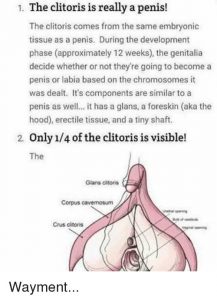
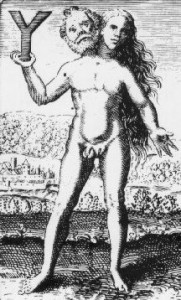 |
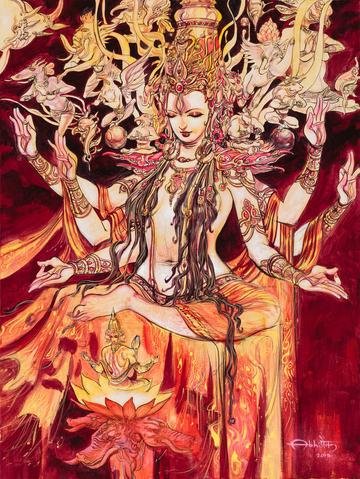
Jung was not the first to recognise that we are male and female. It was seen in ancient times.
|
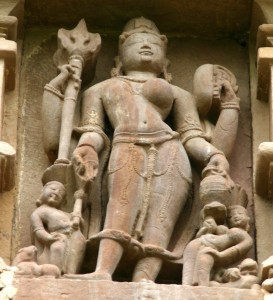
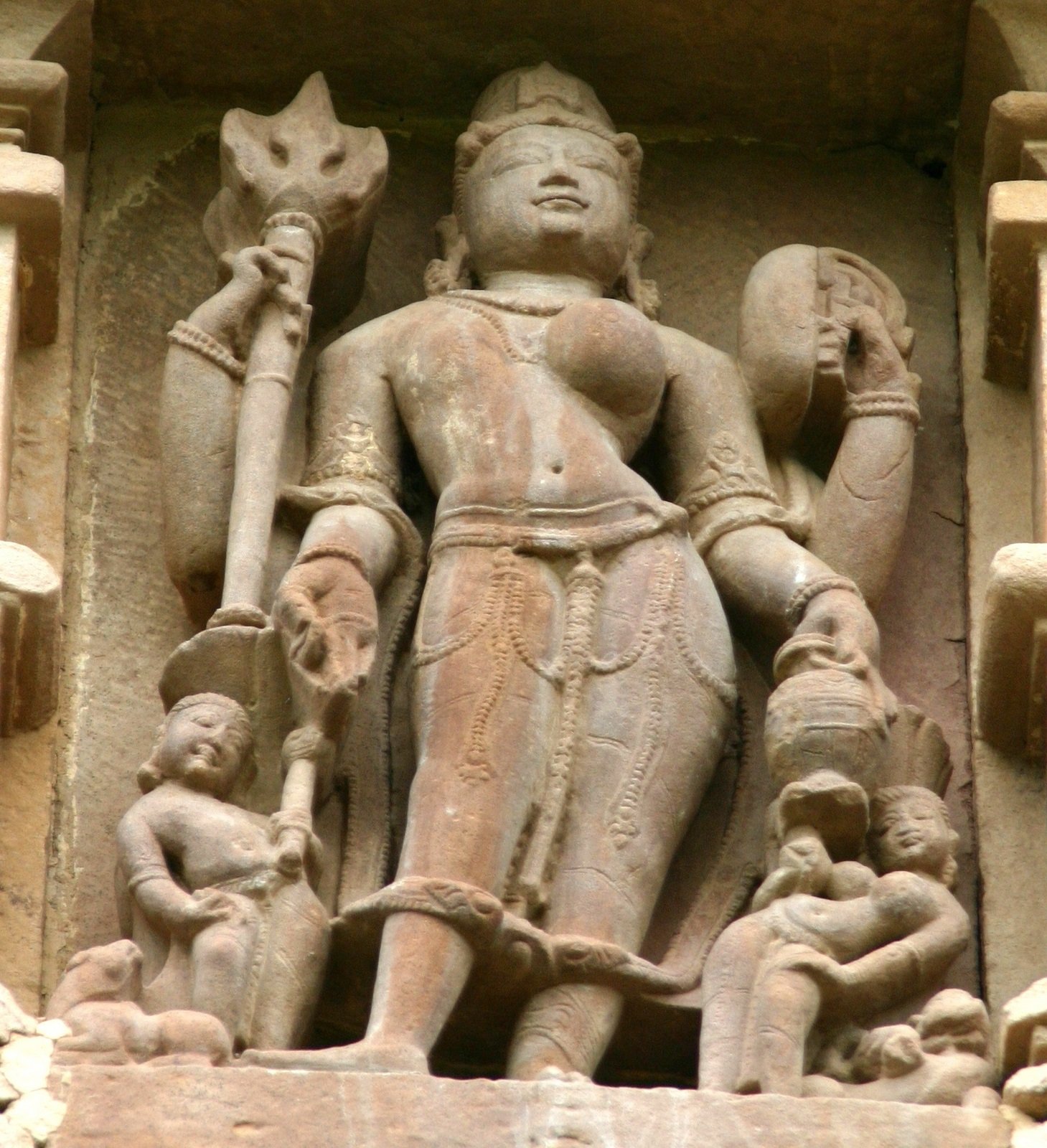
| This is from an older culture and shows Shiva as a male and female figure. It was common knowledge in older cultures that our ultimate nature is everything – which includes male, female and animals, in fact all creation. |
 |
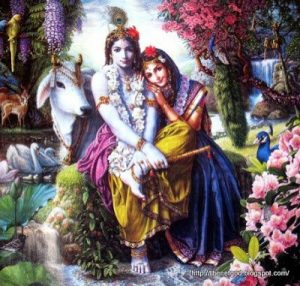
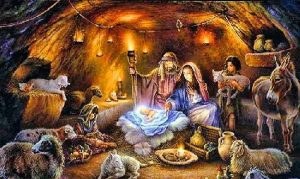
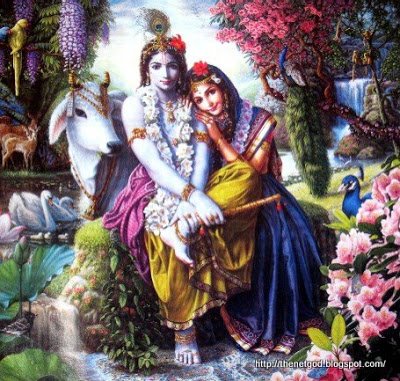
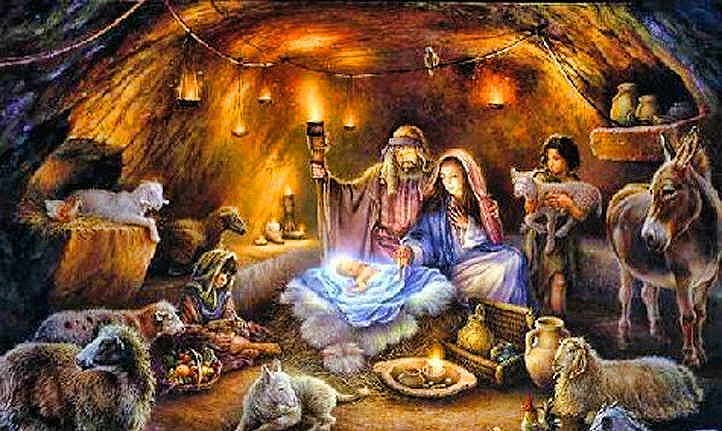
Krishna is shown surrounded by animals, as was the baby Jesus, showing that the divine part of us includes all creatures,
In general we can say the woman represents the man’s emotions, his nurturing and caring quality, forgiveness, his sense of what is natural and his connection with nature, its cycles and drives.
But such insights were also very much a part of our ancient culture. ”
Finds from Avalon Marsh, a bog outside Glastonbury in the UK whose name associates it with King Arthur. The ancient wooden track reassembled here helped people keep their feet dry crossing this wetland nearly 6,000 years ago. Also from Avalon Marsh is a rough wooden idol that’s contemporary with Stonehenge. It has “male and female attributes”, says the catalogue: breasts and a phallus.”
Through such images a man would recognise in people and animals the urges that link one to a mate, the strength to protect and nurture children, and the natural within himself. The anima also holds in it an expression of a man’s complex of feelings about women, gained as experience mostly from his mother – or lack of mother – but also from a synthesis of all his female contacts. So the whole realm of his personal experience of the female, along with the whole racial experience of woman can be represented by the woman in his dream, and is accessible through the image.
The anima is represented culturally in many symbols world-wide. Some of the best known are the Virgin Mary and Sophia in Christianity; Kwan Yin in Chinese mysticism; Kali in Hinduism; Pallas Athena in ancient Greece and Fatima in Islam. At a fundamental level the anima represents the many aspects of mother and nature. Like nature the aspects of the anima can be wonderfully creative and beautiful, powerfully destructive, or even beautifully dangerous. So it can also appear in a dream as a witch, a grandmother, an enigmatic female figure such as a woman of the woods, or a holy woman. Sometimes it is represented by an image such as a tigress, lioness, a woman in a cave, a ship or the sea.
In the Middle Ages there took place a perceptible spiritual differentiation in religious, poetical, and other cultural matters; and the fantasy world of the unconscious was recognised more clearly than before. During this period, the knightly cult of the lady signified an attempt to differentiate the feminine side of man’s nature in regard to the outer woman as well as in relation to the inner world.
The lady to whose service the knight pledged himself, and for whom he performed his heroic deeds, was naturally a personification of the anima. The name of the carrier of the Grail, in Wolfram von Eschenbach’s version of the legend, is especially significant: Conduir-amour (“guide in love matters”). She taught the hero to differentiate both his feelings and his behaviour toward women. Later, however, this individual and personal effort of developing the relationship with the anima was abandoned when her sublime aspect fused with the figure of the Virgin, who then became the object of boundless devotion and praise. When the anima, as Virgin, was conceived as being all-positive, her negative aspects found expression in the belief in witches.
In China the figure parallel to that of Mary is the goddess Kwan-Yin. A more popular Chinese anima-figure is the “Lady of the Moon,” who bestows the gift of poetry or music on her favourites and can even give them immortality. In India the same archetype is represented by Shakti.
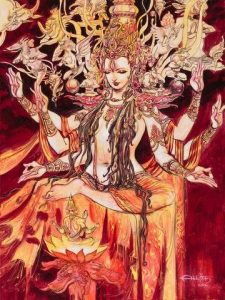
Shakti – Primordial Energy
An aspect of the anima that is often overlooked is in the image of the virgin. It depicts a particular and mysterious potential of the human mind. The virgin represents the ability to clear the mind of preconceptions, and thus open it to intuition. This intuition can lead not only to becoming aware of the aspect of consciousness that is universal – the Self as Jung calls it – but also to forces of change that can transform ones personality. See
Jung stated that there are four stages in the development of ones relationship with the anima. The first is represented by Eve. This stage is a purely instinctual and biological one, and has to do with basic drives to reproduce, and the instinctive drives between mother and baby.
The second stage is a romantic and aesthetic one. Like the first, this still includes sexual elements, but also deals with the personality of the loved one and social processes.
Example of meeting the anima in a young man’s dream: I was at a party in a very large house set in its own grounds. I found the party frivolous, surface talk only, and unsatisfying to my inner feelings. It was dusk outside, but I stepped out of the French window on to the sloping lawns around the house. A large wood rose at the edge of the lawn and I entered it, eventually coming to a lodge house. The gatekeeper, the man who lived at the lodge house, told me I ought to be careful in the wood, as many strange creatures lived in it. I told him I thought I would be all right, and walked on. There were wolves in the wood, I saw them, and a strange serpent jabberwocky type of creature that was forever moving through the trees, but they did not harm me.
I walked on and suddenly came to a clearing deep in the wood. It was still quite light and in the clearing stood the most beautiful girl I have ever seen. She was naked, yet somehow this was natural, as she was brown, and like a creature of the woods. We stood and looked at each other, people from two different worlds, and I knew that if I left my ordinary life, and went into the woods with her, I would find a love such as I had never believed possible. But I also knew that I would be lost to the world; that I too would become a creature of the woods. I was in doubt what to do.
Then, to my amazement, out of the shadows at the edge of the wood, where he had been standing all the time watching me, the god Pan walked to the girl and looked at me. Around him walked tiny creatures of the forest, rabbits, mice, deer and others. Without words, he offered the girl to me and tried to persuade me to come with them to unearthly delights. Then an inner voice spoke to me, telling me to save myself, to resist or I would be lost. I felt a tremendous power of attraction from the girl, as if I longed for her beyond all else, as if she were the answer to all my longings and dreams; but the voice kept on at me, telling me to think of a woman I loved in the outer life, any woman, and thus save myself. I did, for I knew I would be lost otherwise, but there were tears in my eyes as I did so; and the scene faded, and I was back in the wood again, a wood without magic, or fairy love, or unearthly delights or the strange presence and power of the gods. It was just a wood, and I turned away.
The wood here represents all inner ideas and opinions and also the inner self beneath consciousness, the strange unearthly world of the unconscious that can make the drab world magical and full of meaning, turn women into goddesses through projecting strange powers and emotions on to them. Yet it is dire to lose oneself thus, for one may lose one’s sense of identity, be possessed by the gods, or powers of nature active in oneself, and lose contact with the outer life, and family and friends. This is why the dreamer had to think of someone in the Outer conscious life he loved, to re-establish ties with them, to re-stimulate his awareness at that level. But later he returned and blended with her. It is desribed in the example under the Mystical Marriage below. See – The Inner World
The third can be likened to the Virgin Mary.
It depicts a love that has developed possibilities beyond simply the biological, emotional, intellectual and social drives. It shows the possibility of deep self giving and the discovery of experience pouring into consciousness from the unconscious, the birth of intuitive insight. See: Lifestream.
The fourth stage leads to a new form of wisdom in the individual. This can be understood by an overview of the whole process leading through the four stages. To start with the individual’s identity and sense of self has emerged out of biological drives and the instinctual or unconscious reactions that take place between parent and child. The person gains a sense of self from the weakness or strength of their body, their physical prowess or lack of it, the power of their sexuality and how this is responded to by the opposite sex and others. If they have a positive identification with the society in which they live, and if their self expression meets with success or reward, then they may experience satisfaction in the first half of their life. If otherwise they may suffer some degree of depression, anxiety or emotional ill health. See Wild Side
In either case the person has been largely shaped by factors other than their own power to shape their life. They are trapped in what has formed them. The transformation of the relationship with the anima gradually alters this. The individual breaks through the ready made boundaries of their personality and discovers the forces – archetypes and experiences – which helped form them. The ensuing wrestle with self leads to personal insight into ones own life, and into the collective life of humanity. One gains insight into the collective forces, ideas, dynamics, which direct human life. This is spiritual insight. It enables the individual in some degree to gradually find motivation from other than the urge toward sexual reproduction, social power, aggressive domination and self aggrandisement. It isn’t an easy process, but a new type of person emerges from the work. See: The search for Self.
Example: Now I seemed to go into a condition of surrendered, and spontaneous movements arose from within. I reached out and drew the sword. The girl gasped and begged me not to touch, handle, the sword, as it was sacred, or only to be used by a special person. Then she suddenly saw, by my movements, that I was fulfilling the full ritual or ceremony of the sword. It was as if her people had a prophecy about the use of the sword, and whoever handled it in the right way was a leader for the people. Through the inner direction, I had used the sword correctly, and was this leader.
Now she knelt before me, head bowed, in Oriental fashion. The inner movements led me to bring the sword down on her neck – and touch it lightly. This was the last proof of the ritual being fulfilled. Quite without knowing it consciously I had fulfilled the ritual. Also, this last act was a rite of marriage. We were now man and wife. Our relationship was now different, and our depth of feeling for each other made whole.
This an example of a man meeting and integrating his anima, not acting it out by trying to be a physical female. Integrating our female does not mean dressing up in female clothes or even having an operation to change sex. That is further developing an unbalanced self. Integration means having both the female and the male self equally developed. That is wholeness. So therefore being firmly female, male or homosexual are all unbalanced. It takes courage and hard work to achieve this completeness. See Life’s Little Secrets
The negative side of the anima
Is shown as moodiness, irrational feelings, love that clings to what is painful or destructive; hunches that may be prophetic, or expressions of anxiety or jealousy. The dark anima may be depicted in dreams as a witch, or a woman who deals with evil spirits and calls up fear in the dreamer. This dark side of ones emotions is easily seen in the moods that lead to depression and despondency, the dark inner condition that engulfs any joy or achievement and leaves the person feeling irritable, touchy, unloved and unable to love. Perhaps this is why the witch may represent this aspect of our emotions, because unless one can uncover the roots of such despair, it may feel as if one were bewitched, haunted or cursed by such feelings. Or it may be that rather than darkness, one is haunted by the dreams of ideal and wonderful love that only lead one on to misery – a sort of chimera or mirage that tempts but provides no reality.
A slightly different side of this negative anima that Marie von Franz points out is that of the woman/mother who poisons everything, whose waspish, critical remarks hurt and constantly demean. This may live on in a man as self criticism. A slight twist on this is the man who considers himself an intellectual, but actually is possessed by an anima that does not allow real creative thought, but expresses opinions and fears as clever words or arguments. This enables the person to feel themselves always right, and actually avoid any real meeting with other people or life experience. Strangely, such men are often driven to pornography, in a desperate drive to meet denied personal needs.
One side of the anima – the female – that has an ancient history, is the ability the female has for exploring or contacting the unconscious. This is due to the receptiveness and ability to allow something other than her own will to live in her, as a woman does with love, with a foetus, and often with her man. This giving of oneself is sometimes represented by the breast or the womb. In literature and myth we find the theme of the woman guiding the man through the underworld a frequently recurring one – as with Dante and Beatrice, Theseus and Ariadne, Rider Haggard and She. The example dream also shows the female figure as a guide to the spiritual world, a world that was previously unconscious or unknown to the dreamer.
The wonder of the Anima
In talking about this archetype as a symbol, we must however remember what it is a symbol of. Usually any such female figure in a dream can, if explored thoroughly, lead one back to direct experiences in relationship with ones mother. Such primal experiences as we met in being born and nurtured in the extreme of our dependency as an infant, occurred to us prior to speech, prior to organised thinking and perception. They tend to crystallise around an abstract symbol at first rather than around a direct representation of ones mother. This is true of any potent and deeply felt experience that may be difficult to meet as an adult. Difficult because, as an adult we often avoid allowing volcanoes of emotions and reaction such as we see as natural in a baby. Difficult because we avoid feeling so helpless and dependent. See RECORDING
Example: Here one must come to terms with the androgenous psychic nature of man. The anxieties of every human being who ever doubted his own sexuality are true; they point at a wrinkle of the mind which cannot be smoothed away. And therapists who try to calm patients’ fears with reassurances are whistling down the wind. Reassurances will never obliterate the doubt in every man’s mind that he’s not quite all male, or the parallel doubt in woman’s mind, simply because the doubt is psychically valid. Of course, objectively it’s not true at all. Although scientists have pointed out a certain overlapping between the sexes in vestigial organs and hormones, most men are obviously men and women are women. This knowledge of biological similarities hardly prepares men and women for the subjective experience of bisexuality, which can only be explained by the plasticity of the imagination and the sense of identity. In every man’s mind are areas of consciousness that proclaim, in effect, “I am a woman!” In every woman’s psyche occurs the reverse. This is not a matter of observation and analysis but a conviction at the very seat of consciousness. Subjectively, existentially, nothing could be truer than that. Quoted from LSD Psychothery by W.V Caldwell
Whatever aspect of the anima is most pronounced in a man, there is a tendency to project it on to any woman he gets close to emotionally. The woman then appears to be an angel of light, or a destructive witch, or even a femme fatale. Unfortunately women reap the harvest of what has probably been sown by the man’s mother. Mother was the man’s first experience of love, and whatever lessons were learned – whether good or ill – will be lived out with his partner unless they can be changed. Whatever the situation, the man is challenged, perhaps by a love affair that tears his marriage apart, to meet in a more adult way the feelings that were generated in childhood, and may have remained at that level.
Whatever one may make of Jung’s ideas regarding the anima, they remain a useful definition of the variety of ways men handle their emotions and their relationship with a woman they love, or the woman within them. If one is to mature and grow as a person, the childlike dependencies and angers, the blaming and the idolisation must be met and transformed. In doing so one is led into, or uncovers, a wealth of experience within oneself that was previously unconscious. Out of this maturing and growing process the images of the anima as guide and initiator have arisen. All must meet themselves in one way or another in the process of maturing, just as we all dealt with emerging sexuality in one way or another in adolescence. At such a point, the myths and classical stories still portray to us a wealth of information which may support us on our own unique path.
Good dreamt relationship with or marrying the woman
Shows the man integrating his own real emotions, sensitivity and intuition. He is recognising not only his conscious needs, but also the deep needs of his nature within. This makes him more whole, balancing his exterior male qualities and his personal will. As this occurs he becomes less dependent upon an external female to feel whole. It also shows the man meeting his experience of his mother in a healing way. This enables the man to have a realistic relationship with an actual woman. It also brings a sense of connectedness between his conscious self and what he senses as Life, or as Bucky Fuller calls it, Universe. See: Archetype of the great mother below; example of difficulty in integrating anima.
To integrate the anima is often shown in a series of dream in we the man gradually gets closer and closer to the woman and eventually marries her. This can be a wonderful spiritual experience.
Example: My third marriage was to an entirely different type of girl. I met her after experiencing a peculiar sort of time shift, or entry into a new time, or something. She then came to me simply because attracted, and I loved her. She had brown wavy hair to her shoulders, in a round feminine face. Very loving and sympathetic, intelligent, devoted wife, housewife, mother, cook, etc. I remember she had a Bible in her hand. The dream finished with me building three new bedrooms upstairs. She was frightened I would go through another “time change” and leave her. But I assured her. In meeting her, my last wife said, “Weren’t you silly,” meaning marrying the other women when she was always waiting to really love me as I wished to be loved. I said something to the effect that I had been young and stupid, but realised my mistakes.
Example: I was courting an Indian girl on the beach. I had sex with her. All her family seemed to know this. We wanted to get married, and this meant terrific formalities. A banquet was given by her family, and a careful note was kept of what we chose to eat. In some way this was taken as omens, and it worked out unfavourably. We were told we could not marry. I thought seriously about this, and the problems of East marrying West, but still felt we could make a successful marriage, as we loved each other.
Example: As I looked back upon all that in what I am meeting today, I could see that it has been an enormous part of my personal growth over the years right the way back to childhood.
I have experienced a mystical marriage in myself. I am life – and although that is not true, at the same time it is true. In my being I am Krishna and Radha. In me they both live in a wonderful union of bliss. I am both the incarnation of godhead and also the worshipper before that wonder. That this wonder can live in us is beyond my understanding. That it can take on flesh – and that it does, every time a baby is born – leaves me in a state of wonder. I feel all this because I am that blissful union of Krishna and Radha. In myself I know the union and the love. I have been and am that sweet love forever joined. That the very creator of the universe can take on flesh, as it does every time a baby is born, brings me to my knees. This is beyond belief. Yet that is what I am seeing and experiencing as the truth. That is what I am experiencing in myself. I know that in this very existence, lost as I am in the sensory experiences of the world, and my feelings of isolation and physicality, I am at the same time, at the same moment, the godhead itself.
The examples give three stages of meeting the anima.
To be in conflict with the woman, or unable to make real physical and pleasurable contact with her: Suggests difficulty in meeting what may have been a painful or threatening experience of mother. This can lead to becoming an intellectual but emotionally barren man. Or being possessed in a negative way by the female traits, becoming emotionally unstable, opinionated and illogical. Actual relations with women will be difficult. Actual emotional or intimate merging is threatening because it brings the man close to the pain or fear connected with mother. Sex may be possible but not with a close feeling union. See: woman.
The Mystical Marriage
This marriage between the two sides of you is fairly clearly shown in dreams, and even the Bible tells how important this marriage is, “For many are invited, but few are chosen”
Here is a dream showing this wonderful and full union.
Example: I dreamt I was looking at a very large and old tree. I wondered if I could climb it but couldn’t see any way up it. But I noticed a large area without any bark, like an old wound, and I thought that area would become rotten and so the tree would become hollow and offer shelter to animals and humans.
Then I walked around the back of the tree and saw that the bark was like thick cables about 6-8 inches wide. I could then see a fairly easy way to climb the tree. So, I climbed up and the top of the tree was like a massive bell of a flower, like a crocus shape. And it was light and full of colour. Suddenly I saw a spirit, a beautiful female. It was the spirit of the tree. At this point I was semi awake, and I wanted to hold the beautiful spirit, but realised that the tree was a representation of my life, and so was the spirit of the tree. The spirit sat on me in a sexual position, so I was lying on my back and she was upright. She slowly took me into her, I mean the whole me, as if she was sucking my whole body into her. I realised that I had to die because she wanted to take all my experience of life and endeavour into her and fertilise herself to form a baby. So, I was ready to die and watched her form a new baby, a mixture of her and me.
“When you make the two into one, and when you make the inner as the outer, and the upper as the lower, and when you make male and female into a single one, so that the male shall not be male, and the female shall not be female: . . . then you will enter [the kingdom].” Quoted from ‘The Gnostic Apostle Thomas’
Useful Questions and Hints:
Can I recognise my own internal female, and if so what characteristics does it have?
How is my relationship with my internal woman – perhaps in some way a negative image of my mother – influencing my relationship with my female partner(s)?
In my dreams am I ready to marry or unite with my female?
Comments
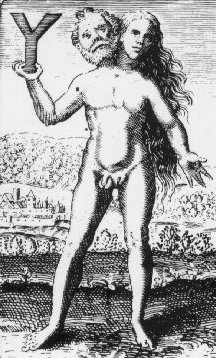
Hi – would you be able to tell me the “Y” symbolizes in the picture of the two headed man on your blog page below? Thank you!:
https://dreamhawk.com/dream-encyclopedia/archetype-of-the-anima-the-female-in-the-male/
Hi – I must take time to upgrade the dream dictionary, so must halt from answering your posts – I started revising the dictionary in 2006, and haven’t neared the end yet. I believe someone else may start giving interpretations.
So, for a while I urge you to read https://dreamhawk.com/approaches-to-being/i-am-no-longer-interpreting-dreams/ – It describes ways that can help you. And often it would help too if you looked at https://dreamhawk.com/approaches-to-being/questions-2/#Summing
Tony
Such pictures were often based on ancient views such as the Kabbalah, so the Y might have been Yahwah – the ancient name for God. See http://heavennet.net/forums/topic/yahwah-is-gods-name/
Hi,
I am so in love with a particular woman.
I have had other relationships before, but I have never felt so attracted to someone before. She satisfies everything that I see as desirable in a woman. I dream of taking care of her and marrying her. When in reality all I want to do is to be close to her, and to let her be free to experience my love for her. I am so confused, and don’t know how to show my love without frightening her. But this webpage, and your work has really brought me on a step. Thanks CG.
CollyG – It is difficult to know how to proceed, but giving small suggestions of how you feel will start the process. Also if you can say happy/joking things it often gets the message through.
Another way is to sit and ask her questions about her and listen to her and carry it forward, always keeping the subject about knowing who she is, what she wants in life, her deepest interests, etc. Have you seen https://dreamhawk.com/relationship-sex/ages-of-love-2/
Tony
Greetings I am so happy I found your site, I really found you by mistake, while I was
researching on Digg for something else, Anyways I
am here now and would just like to say thanks a lot for a
marvelous post and a all round exciting blog (I also love the theme/design), I don’t have time to browse it all at the moment but I have bookmarked it and also added in your RSS feeds, so when I have time I will be back to read a lot more, Please do keep up the excellent job.
well written. Hits home big time.
MZ – Thanks.
I love working on these features – and have the advantage of the internet to search – and of course the experience of several marriages and love affairs.
Tony
Really like your site~ wish I had more time today for more than a couple of articles. Have posted link to my Facebook page, Healing for Emotionally Abused Men~ where is your FB app!?
Thank you, will visit more often
Hi Char – Thanks for your comments, I get a kick our of hearing such things.
But I do not have a Face Book entry – yet. My son, Leon, who is a behind-the-scenes activist for this site, apparently has plans for it. Answering all the dream queries seem to take up all my time anyway.
Tony